Sacred, Profane, & DaVinci Part I
LONDON: Virgin of the Rocks PART 1
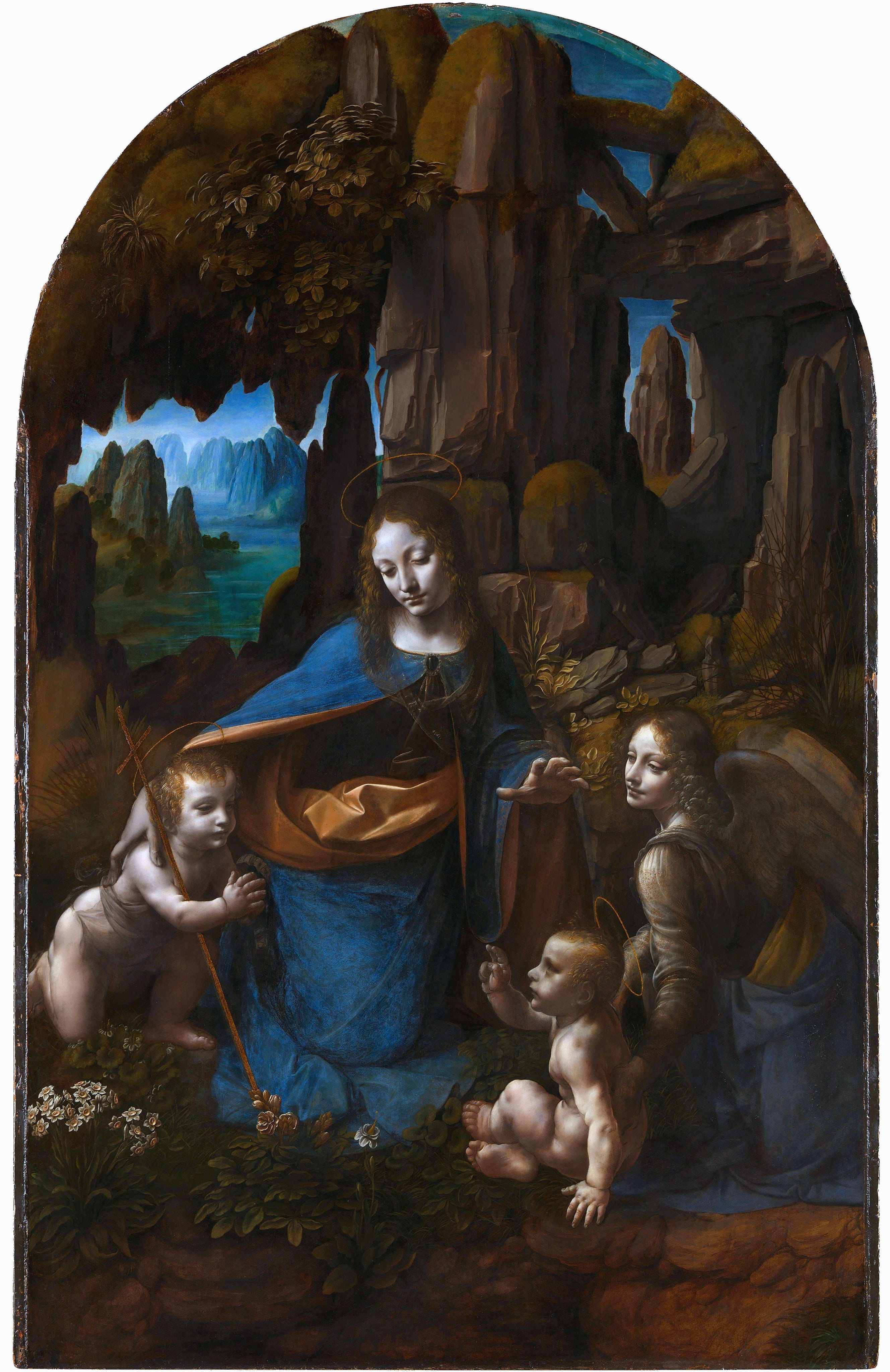
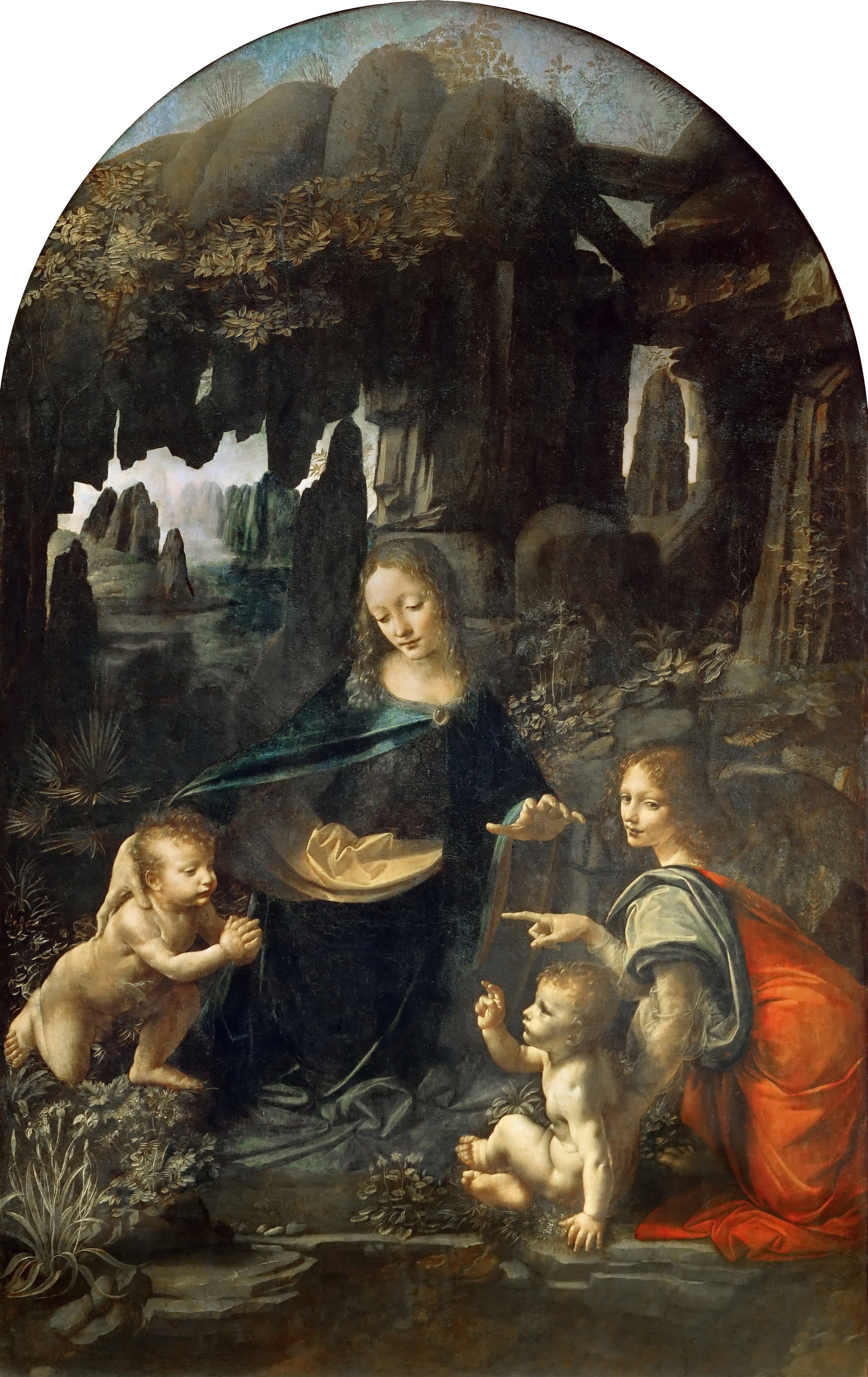
The National Gallery painting is compositionally and thematically at first glance very similar to the Louvre work. Some differences have been noted by scholars, such as the lack of sfumato technique, the inclusion of halos, and the obvious absence of the right hand gestural pointing of the Angel. The attribution is generally that of some work by Leonardo and the rest done in the school of by his assistants. It is by most scholarship considered the second version and therefore a copy of the first. While a minority, some scholars consider it a superior work to the Louvre and representative of a more evolved DaVinci.
The overall subject of both paintings depicts Mary and an infant Jesus during their flight into Egypt to escape King Herod’s plot to kill Jesus. In both paintings we find figures of the Virgin Mary, the Christ Child, and infant John the Baptist, and an Angel. They are all gathered in a grotto of rock formations and Mary is introducing the two infants to one another.
The meeting between Mary and Jesus with John the Baptist and his mother Elizabeth is apocryphal and found in the the Protevangelium of James (17-22). There are many depictions of Mary and Jesus’ journey to escape King Herod’s wrath in art, but the meeting between an infant Christ and John the Baptist is rarely expressed making Leonardo’s subject somewhat unique.
In Leonardo’s paintings, there is no Joseph figure, who according to Matthew 2-13 was instructed by an angel in a dream to take Jesus and his wife away from Jerusalem. Nor do we see the presence of John’s mother Elizabeth (although some have speculated that the Angel holds this dual role). The Angel in the painting is unknown, but traditionally considered to be either Uriel or Gabrielle. Both are plausible. All angels are considered without a specific gender and can be interpreted, or depicted, as either more masculine in form or more feminine.
The Angel Gabrielle was the messenger angel who announced both Jesus’ birth to Mary and John the Baptist’s birth to his father Zechariah. So Gabrielle has strong direct association with both infants in the painting. The name Gabrielle also translates as “Man of God” or “Strength of God” and relates directly to Jesus, so in these paintings to have this angel positioned directly behind the Christ Child figure makes sense.
In the New Testament apocrypha Uriel is depicted as the figure who rescues John the Baptist along with his mother, Elizabeth, from the Massacre of the Innocents. It is Uriel according to these sources who introduces John the Baptist to the Holy Family as is depicted in both these paintings, so this angel is perhaps the stronger choice given the specific subject of these works. I will simply refer to this figure as the “Angel”.
I would like to emphasize that it is universal among all who have considered these two works that they are close enough in composition and thematics to be generally considered two versions of the same painting. This is indeed how things first appear. I am not discounting this fact, but I think that a closer examination will belie this ready and facile comparison.
With regard to this, one of the difference in details is the absence of DaVinci’s exacting reproduction of Nature and the landscape of the National Gallery painting is more fantastical. The National Gallery as well as a host of scholars who valorize this painting above or at least in league with the Louvre painting argue that DaVinci rather than deferring to Nature became a God himself in his creative genius and developed into the assurance of being the creator of his own imaginative world. Freed from the constraints of the imitation of Nature, he is here exhibiting the fuller extent of his creative genius.
Primordial Landscape
Rather than standing in a pool of water surrounded by soft grey shale or slate like rocks that present an inviting Italianate natural “spa-like” experience in the Louvre painting, in the London work it is as if the viewer is transported to Arizona or Utah, with red rocks and no apparent water (some scholars have noted how brilliantly DaVinci here painted clear refreshing water but I don’t sense it). There is also more of a primordial aesthetic that is very different when we compare this lower part of the landscape between the two paintings.
Indeed, these are very different environs, so despite commonalities these paintings are from the ground up built upon radically different landscapes: one more recognizably Italianate and forgiving, the other much more barren, dessert like, and potentially hostile to habitation by humans.
From a geological perspective, the geologist and Renaissance historian Anne C. Pizzorusso has noted the distinct differences between the rocky environments of these two paintings:
“The rocks in the National Gallery painting are synthetic, stilted, grotesque characterizations. They miss the point geologically. Looking at the painting, above the Virgin’s head, there is no change in the texture of the rocks to indicate the presence of the diabase sill. The vertical joint patterns continue upward without interruption. The type of rock remains constant, in comparison to the changes in rock form in the Louvre work…In the foreground, the rocks are not finely bedded. They are roughly weathered and massive, giving the appearance of limestone rather than sandstone. The presence of limestone would be incongruous in this geological setting. The lack of knowledge on the part of the painter of the National Gallery work seems to exclude the possibility that it was Leonardo.”1
Pizzorusso further helps us to appreciate the exacting way DaVinci portrays his geological landscape in the Louvre painting:
“The Louvre painting, on the other hand, shows a congruence in the rocks. Both the sandstone and diabase are weathered and the fracture surfaces are weathered in accordance with the respective hardness of each of the rocks. The result is an accurate portrayal of the sandstones, which have been rounded by water and wind erosion in contrast to the diabase, which is much more resistant, and therefore retains its structural characteristics. Leonardo is able to capture this contrast first, by having an understanding of how the rocks actually look and then representing this appearance realistically through his use of light and color. Leonardo’s use of sfumato and shading suggest the appearance of a moist, musty grotto.”
What is salient is firstly that these are very different landscapes geologically even though their general shape and form are similar. So the content of the National Gallery painting in this regard is not subtly different from the Louvre painting, it is vastly different. We can even assert that what is a natural landscape in the Louvre painting, exacting in its representation of Nature and the natural world (a hallmark if you will of DaVinci that is well established in most all of his works), what we find in the London work is something not only contrary to Nature, but also in direct contrast to DaVinci’s exactitude when it comes to painting or drawing the Natural world. So remarkable is this contrast, this variance and divergence from what we expect from Leonardo, that it makes it highly suspect from a geological perspective, as these observes of this painting contend, that DaVinci painted the London work at all.
Let us continue to examine the details of the London painting without drawing any summary conclusions about its authorship, but rather taking up a possible thematic element presented by this new unrealistic geological landscape we witness here as something un-natural or contrary to Nature itself.
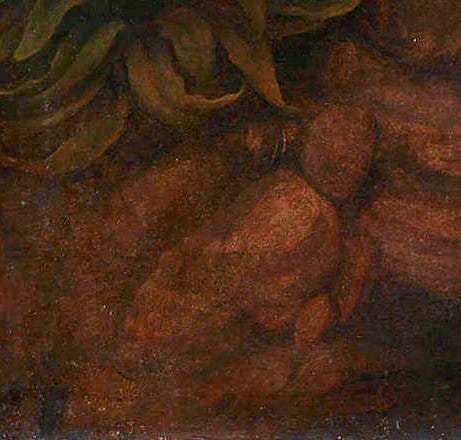
To the left of the viewer, where previously rested a rock evoking baby Moses in the Louvre painting is what resembles a red turtle. The shell, head, and two fins can be seen as it appears to move upwards onto higher ground. The image of this rocky turtle is crawling upon what then appears as a curled up snake. Here we have a rhetorical doubling of a reptilian theme lending credence to an interpretation of the red rocks forming the image of a turtle. I have taken the liberty to animate the head of the snake as I see it just a bit. I invite you to compare the two images and ask yourself what you see or imagine.
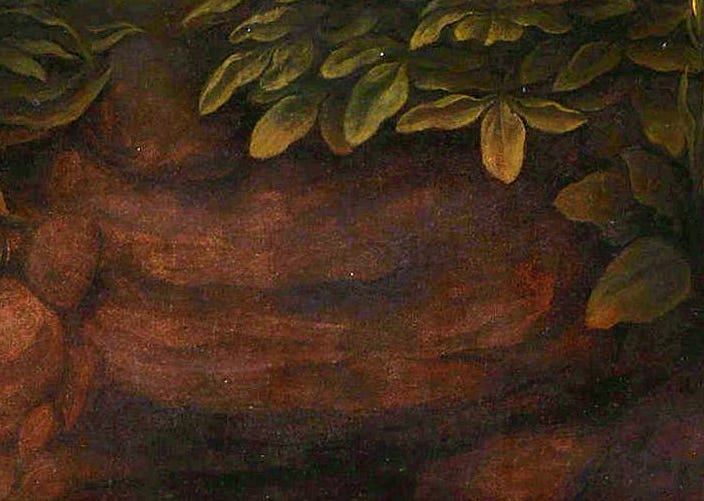
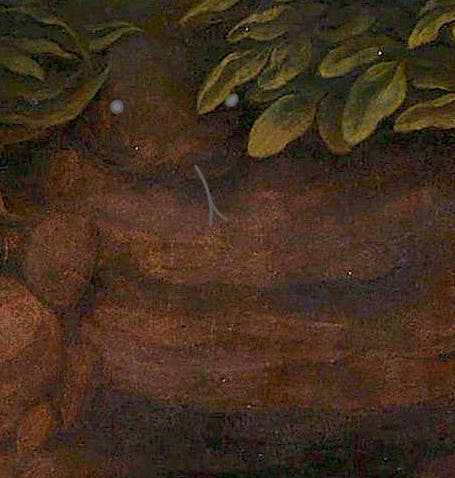
Especially in comparison to the Paris work, this landscape does not secure me beyond a doubt that this is the best choice of a place for a suggested baptism. The sides seem perilously high, more like a cistern than a shallow inviting pool, the rocks rough and not in the least bit comforting. The overall feeling is one that leans towards paranoia and discomfort rather than a place of divine comfort and solace.
Pit of Hell
As we maintain a sense of relationship between these humans and their environs, between humanity and the natural world, some of the imaginary elements of the London work begin to play upon the imagination. Even though the London painting ventures into the fantastical, the images are held within a Christian context that provides a cohesive landscape. The plant to the right of the figure of Mary in the London work has elongated almost worm-like shaped tips. The leaves themselves resemble flames. Overall, the effect is of a fire, contained within the hollow of the rock almost in a semi-circle. This semi-circular shape is reflective of the semi-circular rocks that we as viewers of this painting are perspectively placed in.
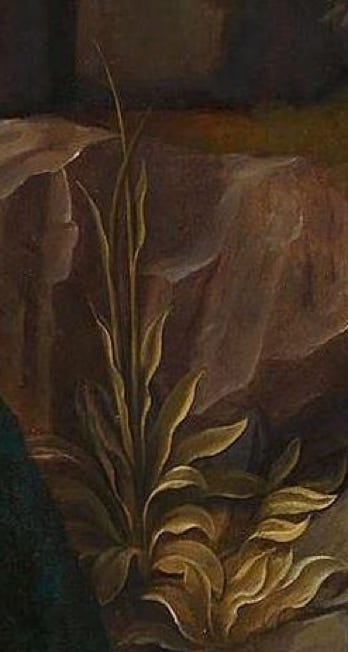
Now the image of a sort of “burning bush” is not necessarily contrary to a positive Christian interpretation of Biblical thematics, yet it also holds the metaphoric promise of a fiery pit, a kind of natural hell, where anything that is placed in this environs is burned by the flames it holds.
The effect of a rocky pit that holds fire, with flames licking up from the rim of the top, also mirroring the rocky pit that we are standing in as viewers is another element of this painting that brings on a purely subjective level much more discomfort than consolation. It presses the question further as to what type of environment are we encountering here: what is this nature, and what too are is the true nature of its inhabitants?
Where too is the baptismal water? I feel when confronted with this painting as if I am standing in a pit devoid of any water, not a shallow pool as in the Louvre painting. By extension, what does this alternate landscape provide as a reference for the figures that we find inhabiting it? Can we begin to imagine, say, John the Baptist without a suitable place to perform a baptism? How might this new landscape impact the figures in the painting and how we see them?
More directly, how does this landscape present itself to us individually compared to the Louvre work? The conclusions of so called experts that this alternate landscape either denotes that DaVinci did not paint it since it lacks the Natural realism we expect of him, or that it was painted by assistants, or that DaVinci here was expanding into his full imaginary genius and acting as a sort of God artist letting his fantasy run wild. These are all speculative answers that are based on a shallow reasoning that looks for easy one answer explanations without implementing more careful consideration.
By way of this, it is limiting at best to stay so confined within the mindset of objective reasoning. Pizzorruso’s objective observations of this landscape based upon geological science are astute and praiseworthy; however, her summary conclusion that this evidence proves that DaVinci did not paint it is rash and even puerile. Even if such a conclusion of dismissing DaVinci as author seems logical, one would need to consider more in depth the implications of this change in landscape.
Here is needed a shift from objective reason to a more subjective one. A landscape that is contrary to Nature is a good starting point and perhaps the most important one, yet there are other elements particularly resonant within a Christian context that are being presented. One of the qualities of this un-natural environment, which resembles, or reminds me on a subjective level trips I have made to the desert of Utah and Arizona, is that it is not very hospitable. This is one of the marked distinctions between the two painting’s landscapes.
Hospitality is central to Christian faith. We recognize the Christian gesture of hospitality in the angel of the Louvre painting who gazes at us and welcomes us into the artwork. While human hospitality differs from hospitable environs, the two are not unrelated. In the London painting there is no angel welcoming us, and the landscape is an inhospitable one. Perhaps this is the artists intent to convey the Holy Family as truly in a place of exile, in a desert environs that is inhospitable. In this sense, the landscape may be closer to the Apocryphal tale than the Louvre work, more exacting from a narrative standpoint. We will expect from a more in depth examination of the painting that the meaning of this environment will become more apparent.
What is remarkable to me is how these paintings are considered by most to be equivalent, one a copy of the other. Yet, such a dramatic change in environs, while structurally similar from a compositional viewpoint, make them very different from the outset. In other words, objectively a comparison of similarities make them technically, or from a measured and scientific approach, very alike; yet from a subjective perspective as viewers placed before and thus brought into the paintings, they are very different. This is experiential and not just mental, subjective as well as objective.
Natural Distortions
As we continue to examine specific elements in this painting, we have already established a potential theme of the un-natural, or things that are contrary to Nature. We can use this theme as a hypothesis to determine if DaVinci is following such a strong religious topic in the rest of this painting. What is Natural then in a Christian context is generally attributed to God, while that which is contrary to Nature belongs to the realm of the Demonic.
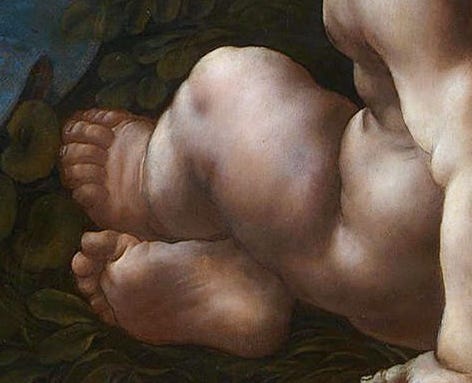
Approaching the left leg and right foot of the baby Christ child as they are painted here in the London painting are as much of a contrast from the Paris work as are the geological landscapes. We are all used to seeing a fleshy and healthy chubbiness in DaVinci’s children, yet the representation, particularly of Christ’s left foot, is a distortion of what most anyone would consider natural or even healthy.
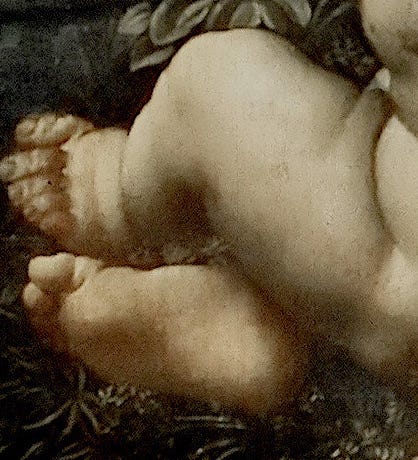
Indeed, it almost appears to be a club foot and the entire leg does not reflect a healthy chubby baby fatness, but is rather swollen and exaggerated as if diseased. In point of my own subjective truth, if my child’s leg looked like that I would take it immediately to the doctor. There is a distinct movement here accross the boundary of a natural healthy expectation of a well fed infant into the grotesque.
With our imaginary forces activated by a strange and unusual landscape, Leonardo has invited us into a world that is unique and defies some of our expectations of its overt religious theme and surface appearance. For example, on closer examination of the Christ child’s left leg there is a strange formation at the thigh. To my eye it appears to resemble a dead pigeon. The formation is indeed highly unusual, and what child have you ever seen with what looks like a dead bird underneath their skin?
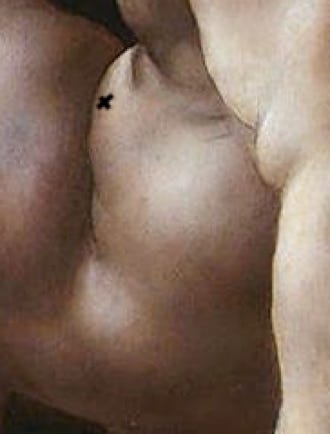
Take a minute to check your own leg for a visual comparison. If you happen to have an infant nearby check to see how their legs appear in comparison. This is not anywhere in the realm of normal expectation, nor is it very naturally or realistically rendered. Were DaVinci’s assistants that poor in draftsmanship? And with our established knowledge of DaVinci’s exactitude in portraying nature, if he is the artist what might in play here?
Furthermore, if the element of a pigeon is intentional then it has resonance within a Christian context. The dove as a symbol of the Holy Spirit is a veritable icon we are all familiar with. It is also associated directly with Christ and his baptism as in Luke 3-22 “And the Holy Spirit come down in a bodily shape, like a dove on Him.” So the representation of a dove in a painting that holds a central theme of the baptism of Jesus by John is in our expectations (and not some fantastical or random image).
However, rather than soaring in flight, this dove is bound into the flesh of the Christ child. The thigh in Renaissance religious art was associated with passion, either earthly or heavenly, and was a local for sensuality. The thigh is also an established euphemism for the genitals and of procreation. The loins is where offspring are biblically referred as being “engendered” especially as it relates to male lineage and fecundity. The image of a dove associated with Christ, especially in the location of passion or generation, is not problematic per se as we might consider Christ’s passion, or more precisely the passion of Christ to be informed by and related to the Holy Spirit.
The prominent Christian concept presented here and to the Catholic Church is the filoque, the major tenant of Western Catholicism that distinguishes it from its Easter counterpart. Here is the emanation of the Holy Spirit, not just from the Father, but also from the Son. From an Eastern perspective, there is an incongruity with the suggestion of Jesus Christ giving potential birth to the Holy Spirt, rather than being informed through baptism by it, or born of it through the Virgin Mary. This metaphoric conceit as presented in this painting is not counter to Western Christian theology that might have the Christ Child as emanating the Holy Spirit, yet to place it so specifically at the place of sexual generation does stray a bit from our established Christian ideas of the nature of the relationship between Christ and the Holy Spirit. Foremost is the possibility of a suggestion here of an incestuous relationship between Christ and the Holy Spirit, a relationship located not in the heart, but rather in the loins, although this is the generative center and does make perfect sense, yet in no artwork have I ever seen the filoque represented so graphically as part of Christ’s loins. Renaissance religious art is replete with sexual imagery, so the sexual nature of the image is not itself suspect, rather how this metaphoric image as a conceit functions within a Christian context. Indeed, this is a very unusual and remarkable portrayal of the dove of the Holy Spirit non parallel in any artwork I am familiar with. Foremost here, though, is the implication that this dove is stillborn, a dead creature rather than a living emblem of the Holy Spirit.
We are also invited to consider the image of this bird not purely from an intellectual perspective, but also from an emotional one. For me, there is an ill feeling that I get when I see this image of a lifeless bird - especially in relation to a perspective and belief that imagines Christ as the bearer of eternal life, and not of death. Further examination of this painting will help us to confirm this image of the dove as either a positive affirmation of the Holy Spirt, or something contrary, or un-natural, to Christian theology.
The Christ Child
A further remarkable comparison between the two paintings is to be found in the differences between the heads of the Christ child.
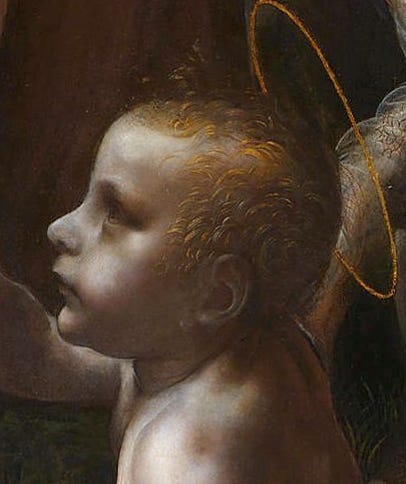
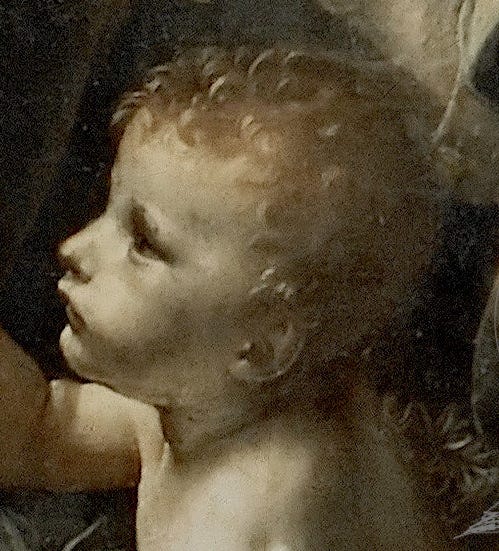
The London version shows us the divine Christ child as what in contrast to the infant head in the Paris work appears to be a middle aged man replete with a receding hair line and hair cropped around the ears in Roman fashion. An aquiline nose too not of an infant but of an adult, as well as a pronounced chin that brings the lips in alignment to denote a well developed capacity for oration. It is by no means surprising for us to witness in religious art the depiction of the Christ child as a more mature adult. This is commonplace in Medieval as well as Renaissance portrayals. It is unusual though for DaVinci, and this is the only painting of religious themed figures of infants where he departs from what is a more realistic and natural expression of children and gives us a depiction of the Christ child as closer to representing a full grown adult.
Unlike the Louvre version, the ear is placed in horizontal relationship with the ground, rather than turned heavenward as in the Paris painting. The forehead too is accentuated as predominant and the receding hairline emphasizes this physiognomy. The eyes appear sunken in dark shadows of the brow, and the color of hair is a brilliant gold (almost chromatically akin to the halo behind his head) and is much less natural than the reddish tinge found in the Paris painting. The halo too, is somewhat curiously placed as an elliptic that seems to operate more directly with what is behind the figure than what is above. Relating directly with the Angel behind this Christ child.
As with all of the figures in this painting, illumination occurs from somewhere outside of the painting in the upper left, as if there was a giant single Hollywood Klieg lamp used to illumine the scene. In other words, there is nothing subtle at all about the illumination of this figure and what we see are stark contrasting light and shadows, as well as an abandonment of DaVinci towards any sense of natural subtlety, or even an inward light of divinity in this figure. In the dusk, the Paris figure we can imagine will still have a certain luminescent presence, but the London child will be cast into total darkness. Indeed he is already half-way there.
All of these nuances add up to a less angelic and more earth bound figure. Again, the choice by DaVinci to portray the Christ child as more of an adult is not unique, but what does stand out is how much this child resembles a Roman emperor - arguably much more so than a Christ figure.
The Roman emperor most directly associated with the subject of this painting is Ceasar Augustus, who’s census for the purpose of proper taxation required everyone to register in their original home of birth. And so a pregnant Mary and Joseph traveled to Bethlehem. Here is a direct relationship of power and influence, but more generally there is associated with Augustus a direct comparison with Christ as both were considered Saviors. According to Apollonius of Menophilus Azanitus from the Priene Calendar Inscription (9 B.C.):
“Since Providence, which has ordered all things and is deeply interested in our life, has set in most perfect order by giving us Augustus, whom she filled with virtue that he might benefit humankind, sending him as a savior, both for us and for our descendants, that he might end war and arrange all things, and since he, Caesar, by his appearance (excelled even our anticipations), surpassing all previous benefactors, and not even leaving to posterity any hope of surpassing what he has done, and since the birthday of the god Augustus was the beginning of the good tidings [εὐαγγέλιον] for the world that came by reason of him.”
Furthermore, one of the prominent titles Augustus held for himself was Divi Filus or the “Son of God.” His coinage bore this title and found authority since he was the adopted son of Julius Caesar who himself was given the status of a God. In the case of many Roman emperors divinity was claimed, but Augustus was indeed worshiped as a God by a great number of the people he ruled over. Augustus was also commonly referred to as Dominos or “Lord” and the kingdom of God was the very kingdom that Augustus brought peace too as the fulfillment of the Pax Romana. All of these accolades were not in any sense superfluous since Augustus himself had achieved what had been deemed the impossible. His greatness was undeniable.
That Christ’s claims, or those of his followers, mirrored in many ways those of Augustus created a comparison between the two not simply engendered due to their proximity in historical time. With Augustus holding the status as a champion in the earthly realm of Man, and Christ the champion of a Heavenly mandate. Augustus did not then represent the anti-Christ per-se (a title more freely given to Nero), yet he did provide the perfect representation as to what being the Son of God in terms of a Kingdom of Man represented within the limits of the Roman Empire, in contrast to Christ as bearer of the Kingdom of Heaven unto the Earth and to all Mankind. This comparison then afforded the earthly savior of Augustus as a standard measure of all things that Christ is not. We can extend this to our interest in defining the Profane and the Sacred, with this specific example as a very good representation of how the Sacred and the Profane has been illustrated in Christian tradition.
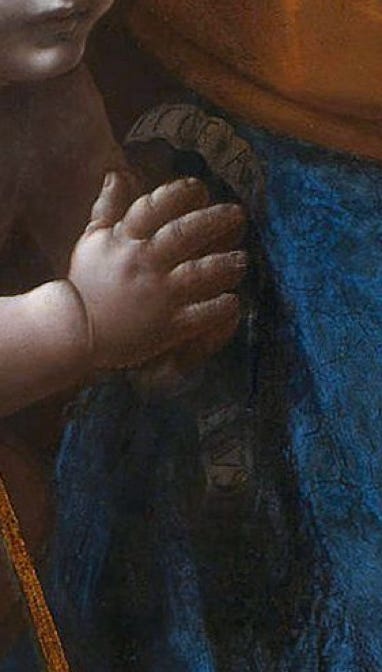
With these general distinctions in mind, the banderole or ribbon that is represented just behind the infant John the Baptists clasped hands in the painting is readily recognized to read Ecce Agnus Dei, or behold the Lamb of God repeated. This is the expectation, a very common artistic Christian motif, and what this obviously is meant to represent. However, although Ecce is clearly represented, only the A of the religious text is present as well as U and S made out at the lower part of the scroll. This creates an intentional ambiguity by DaVinci.
In other words, while Ecce or behold the lamb, or son, of God claims Christ as the Savior, it is possible to just as well read this banderole as “Ecce Augustus Caesar”, or Behold Augustus, the Son of God and the Savior. Both are entirely plausible in the context of Christ and of Augustus, and DaVinci leaves the reading of this scroll very open to the attribution of Augustus as the proclaimed Son of God in this painting. This could hardly have been accidental given all the other representations of such banderoles in Renaissance artworks that do not obscure the letters (rarely at all) and in such a specific manner.
This imagistic rhetorical doubling closes the gap of contingency exponentially, not just as creating two possible references to Augustus, but playing on the well established tradition of comparison between Augustus and Christ in terms of divine right. This can hardly be coincidental or accidental. For those who wish to maintain the position that the Christ Child in this painting is in fact Christ and in no way suggestive of Augustus, or that the scroll obviously holding the expectation to read Ecce Agnus Dei in no way suggests “Behold Augustus Caesar”, then I invite you to hold that doubt while we investigate more details of this painting moving forward.
Pizzorusso, Ann. “Leonardo’s Geology: The Authenticity of the Virgin of the Rocks.” Leonardo 29.3 (1996): 197-200.